
AI Financial Reporting for Enterprises: Audit-Ready Control
AI Financial Reporting for Enterprises: Audit-Ready Control

AI financial reporting, in the enterprise context, means converting every AI/ML API request into a metered, auditable economic event with a clear owner, workflow, model, cost, and outcome. The recommended first step: stand up an AI control plane that intercepts all provider calls, stamps request-level metadata, and enforces per-request policy before any token is consumed.
Capture these fields at minimum on every request:
- owner_id and authenticated_user_id (dual attribution for SOX)
- org/team/project/agent tag chain
- model_id, provider, input_tokens, output_tokens, cost_estimate
- workflow_id, outcome_id, policy_result, retention_mode
McKinsey finds that 20–30% of enterprise AI spend goes unaccounted for because it is fragmented across providers, tools, and business units. That gap is what an AI control plane closes.
Key Takeaways
| Point | Details |
|---|---|
| Start with the tag namespace | Define org/team/project/agent before routing any traffic; retrofitting tags after go-live is the costliest mistake. |
| Showback before chargeback | Share per-team cost statements for two full cycles before enforcing hard chargebacks to ensure tag accuracy. |
| Dual attribution is an audit requirement | Log both AI system identity and authenticated human user per request to satisfy SOX individual-accountability tests. |
| Budget against P90, not P50 | Agentic workloads can spike costs by multiples; P50 forecasts routinely understate actual spend under stress. |
| P402 for end-to-end metering | P402 meters every AI request, enforces per-key budgets, routes across 300+ models, and exports ASC 350-40 evidence bundles. |
Table of Contents
- Why an AI control plane is the foundation of audit-ready reporting
- What fields must you capture per AI request?
- What do auditors require to capitalize or defend AI spend?
- Step-by-step implementation playbook
- What reports and metrics does finance actually need?
- How should you architect the integration?
- What pitfalls and optimization levers matter most?
- How do you forecast AI spend accurately?
- What practitioners learn implementing enterprise AI financial reporting
- P402 delivers the full playbook in one platform
- Sources
Why an AI control plane is the foundation of audit-ready reporting
An AI control plane sits between your application layer and provider SDKs. It enforces visibility, policy, and routing at request time — not after the invoice arrives. That distinction separates it from retrospective billing dashboards, which document cost but cannot prevent waste.
Traditional FinOps tools aggregate monthly bills. A control plane intercepts each call, stamps attribution tags, applies budget rules, and routes to the appropriate model before the request executes. Quali’s analysis makes the case directly: retrospective dashboards are insufficient for agentic workloads, where enforcement must occur at provisioning and request time.
Control-plane capabilities map to finance needs as follows:
- Showback/chargeback: tagged events GROUP BY team/project yield per-department cost statements without manual reconciliation.
- Return on AI (RoAI): BCG recommends measuring cost per successful outcome rather than gross token spend — RoAI = economic return / (cost of human time + cost of tokens).
- Unit economics: per-workflow cost trends surface which products are profitable at the inference layer.
What fields must you capture per AI request?
Every AI request must produce a structured metered event. The table below maps each field to its finance or audit purpose.
| Field | Finance / Audit Purpose |
|---|---|
timestamp |
Ties cost to accounting period |
request_id |
Unique event identifier for ledger reconciliation |
org / team / project / agent |
Attribution tags for showback and chargeback |
owner_id + authenticated_user_id |
Dual attribution for SOX individual-accountability tests |
model_id + provider |
Model-mix analysis and vendor invoice reconciliation |
input_tokens + output_tokens |
Token volume for cost calculation and forecasting |
cost_estimate + cost_actual |
Budget variance tracking |
workflow_id + outcome_id |
Cost-per-outcome calculation |
policy_result |
Audit evidence that guardrails fired |
retention_mode |
Privacy compliance (metadata-only vs. prompt retention) |
No service should call provider SDKs directly. Route everything through a gateway that stamps a virtual key with the full tag chain at provisioning time.
Pro Tip: Design the tag namespace once as org/team/project/agent. A single GROUP BY project on the event ledger then yields immediate cost attribution with no post-hoc tagging effort.
What do auditors require to capitalize or defend AI spend?
The metered event ledger is the audit evidence. Each event is a timestamped, policy-stamped record that auditors can trace from a vendor invoice back to a specific workflow and owner.
Under ASC 350-40, auditors typically require the following documentation package:
- Project authorization: signed management approval with funding commitment and probable-completion assessment
- Capitalization start date: documented milestone when preliminary project stage ended
- Time tracking: labor allocations mapped to JIRA/GitHub tickets, by phase (development vs. post-implementation)
- Cloud tagging: resources tagged by project and environment (dev/staging/prod) in the provider console
- Monthly capitalization memos: rollforward schedules reconciling additions, disposals, and amortization
- Vendor invoices: matched to metered event exports by period
- Impairment procedures: documented annual review with triggering criteria
Kognitos flags dual attribution as a frequent audit finding. Log both the AI system identity and the authenticated human user per decision, backed by SSO session binding. Where feasible, add cryptographic tamper-evidence to the event log so auditors can confirm records were not altered after the fact.
Step-by-step implementation playbook
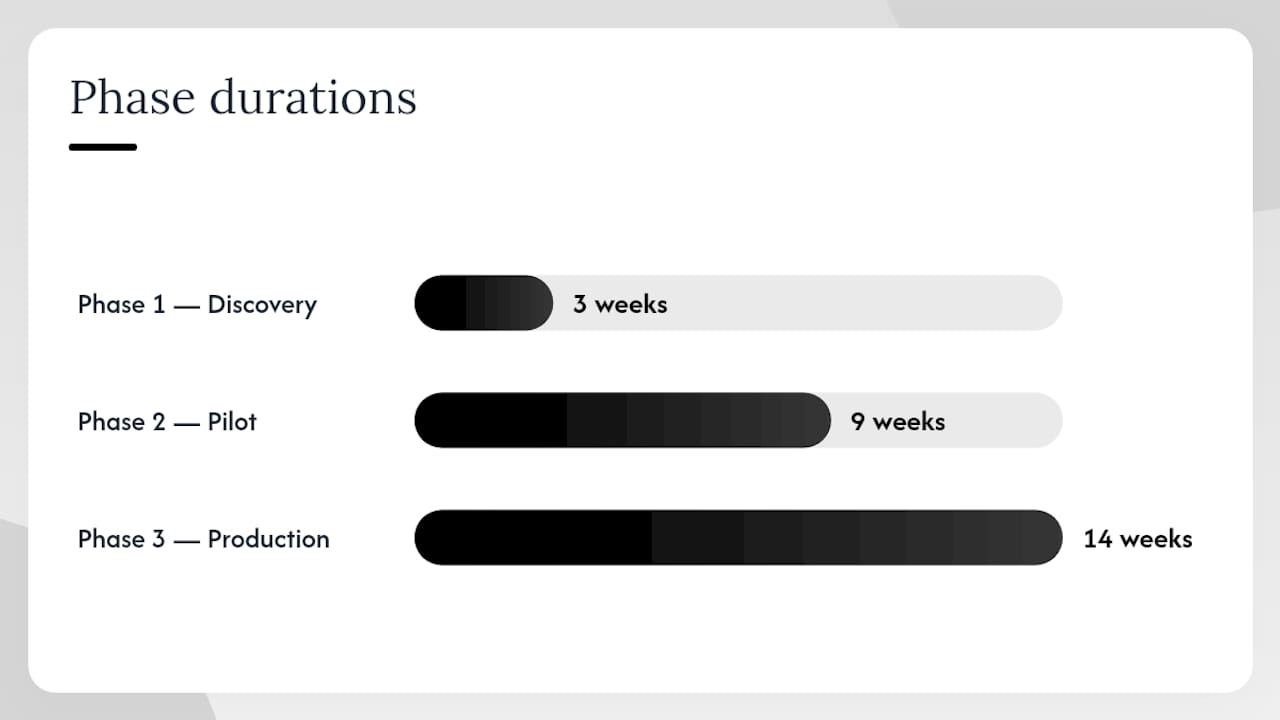
Phase 1 — Discovery (weeks 1–3)
- Inventory all AI endpoints and provider accounts across the organization.
- Map each endpoint to an owner (team, cost center, product line).
- Estimate monthly token spend per endpoint using provider billing exports.
- Identify the top 5 workflows by token consumption — these are the pilot candidates.
Phase 2 — Pilot (weeks 4–12)
- Route pilot-workflow traffic through the control-plane gateway.
- Apply the
org/team/project/agenttag namespace to all virtual keys. - Enable showback dashboards; share per-team cost statements weekly.
- Validate unit-economics metrics (cost per resolved ticket, cost per processed document) for 2–3 workloads.
- Acceptance criteria: 95% of pilot requests tagged, P50/P90 cost forecasts available, TTL enforcement active.
Phase 3 — Production roll-out (weeks 13–26)
- Enforce gateway routing for all AI traffic; block direct SDK calls via network policy.
- Set per-team hard budget ceilings and kill switches.
- Enable intelligent routing to reduce frontier-model usage.
- Integrate the event ledger with GL/ERP via scheduled exports; automate monthly capitalization memos.
Primary cost drivers: integration engineering (gateway deployment and SDK migration), control-plane licensing, analytics instrumentation, and audit evidence packaging.
Particula’s AI FinOps framework recommends starting with showback before enforcing hard chargeback — visibility alone corrects a significant share of waste before enforcement is needed.
What reports and metrics does finance actually need?
Core metric definitions:
| Metric | Calculation | Owner |
|---|---|---|
| Cost per successful outcome | Total cost / successful outcome count | Finance + Product |
| Blended model cost | Weighted avg cost per 1K tokens across model mix | Platform |
| Token mix | % spend by model tier (frontier vs. mid vs. edge) | Platform |
| RoAI | Economic return / (human cost + token cost) | Finance |
| Chargeback amount | Tagged cost × markup rate, by team | Finance |
Sample report row — support-agent workflow:
Showback runs first: share cost statements with team leads, collect feedback, and let teams self-correct model selection and prompt efficiency. Move to hard chargeback only after two full showback cycles confirm tag accuracy.
How should you architect the integration?
The canonical architecture: control-plane gateway in front of all provider SDKs → event ledger (append-only, timestamped) → analytics layer (showback dashboards, P50/P90 forecasts) → GL/ERP export path. Optional: on-chain settlement for immutable audit trails.
Integration specifics:
- Stamp tags at the virtual key level, not the application level, so tags survive SDK upgrades.
- Enforce per-key budget ceilings and kill switches at the gateway; do not rely on application-layer logic.
- Assign per-environment TTLs (dev: 7 days, staging: 30 days, prod: per-contract) to prevent forgotten agentic workloads from consuming tokens indefinitely.
- Route requests by a classifier that scores task complexity; reserve frontier models for tasks that require them.
Pro Tip: Default to metadata-only capture. Store prompt hashes or reversible encryption only when auditors require actual prompt content for a specific compliance regime. Record model versions and change events as separate ledger entries so auditors can reconstruct the model state at any past decision point.
Common integration pitfalls:
- Services bypassing the gateway and calling provider SDKs directly
- Inconsistent tag namespaces across teams (e.g.,
projectvs.projvs.prj) - Missing dual attribution when shared service accounts make API calls
What pitfalls and optimization levers matter most?
Common failure modes at scale:
- AI sprawl: ungoverned model proliferation across teams with no central registry
- Untagged spend: shared service accounts with no owner attribution
- Agent retry loops: agentic workflows that multiply token consumption by 30x or more due to uncapped retries — BCG documents this risk explicitly
- Prompt bloat: oversized system prompts passed on every request
- Weak lifecycle policies: forgotten dev environments consuming tokens for months
Highest-impact optimization levers, in priority order:
- Intelligent routing to lower-cost models for tasks that do not require frontier capability — the single highest-leverage lever
- Caching and prompt reuse for repeated queries within a session or across users
- Prompt compression to reduce input token counts without degrading output quality
- TTL and lifecycle enforcement to terminate idle environments automatically
- Per-key hard ceilings and kill switches to cap runaway agent loops before they materialize as invoice line items
How do you forecast AI spend accurately?
Linear extrapolation fails for agentic workloads. A single agent loop can consume tokens non-linearly depending on retry depth, tool-call chains, and context window growth. Forecast against three scenarios.
| Scenario | Key Drivers | Data Source |
|---|---|---|
| P50 (base) | Current query volume × blended model cost without agent growth | Event ledger, recent days |
| P90 (stress) | +30% query growth and increased use of frontier models and agent retries | Capacity plan + model roadmap |
| High percentile (spike) | Agentic loop failure, caching disabled, full frontier-model fallback | Incident history + vendor SLA |
Sensitivity inputs to model: model mix shift, queries per active user, agent loop depth, caching hit rate, and provider price changes. Set budgets against P90. Maintain a contingency reserve for experimentation workloads that intentionally run outside normal parameters.
What practitioners learn implementing enterprise AI financial reporting
Three lessons emerge consistently from enterprise rollouts. First, start with attribution before anything else — untagged spend cannot be governed, and the tag namespace is the hardest artifact to retrofit after traffic is live. Second, showback precedes chargeback; teams that see their costs self-correct model selection and prompt design faster than any top-down mandate achieves. Third, enforce governance at provisioning time, not at billing review. By the time an invoice arrives, the waste has already occurred.
The organizational structure that sustains these controls is a cross-functional AI FinOps team: finance, platform engineering, and product owners meeting on a recurring cadence (monthly at minimum) to review showback reports, approve model additions, and update budget ceilings. Without that governance rhythm, even well-instrumented systems drift.
P402 delivers the full playbook in one platform
Real-time AI spend attribution without the six-month integration project. P402 converts every AI/ML API request into a metered economic event — owner, workflow, model, tokens, cost, outcome, policy result — and surfaces that data in an Enterprise AI Budget Dashboard with showback/chargeback views and P50/P90 forecasts built in.
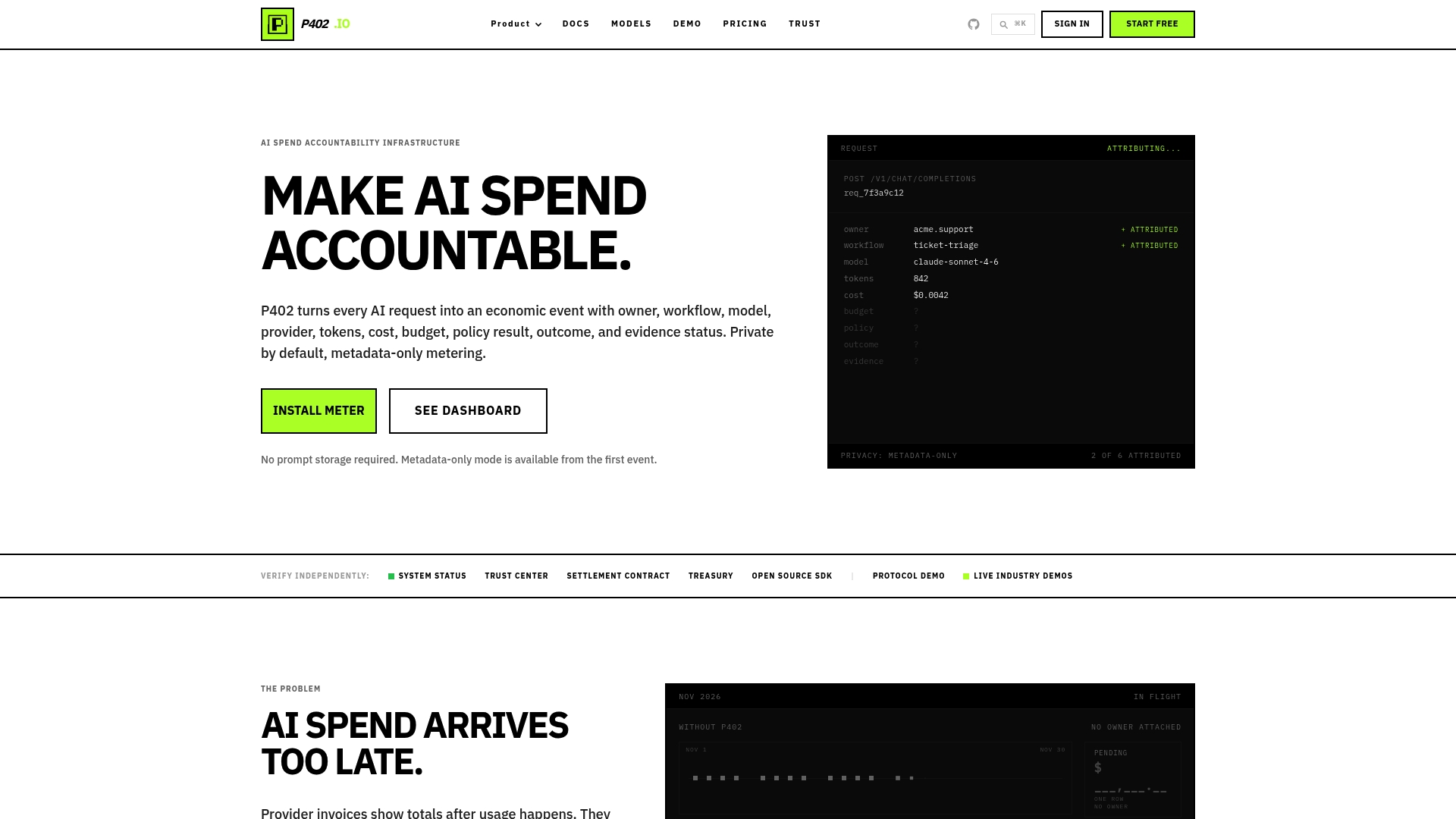
For compliance teams, P402’s AI Spend Audit exports produce the evidence bundles auditors require under ASC 350-40: time-series ledger exports, rollforward schedules, and capitalization memos. Metadata-only capture is the default; prompt-hash and reversible-encryption modes are available when a specific compliance regime requires more. Routing across 300+ models is native, with per-key budget ceilings and kill switches enforced at the gateway layer. A typical pilot runs 8–12 weeks from gateway deployment to validated showback dashboards. Request a pilot engagement at p402.io to scope your deployment.
Sources
The following sources underpin the recommendations in this guide and provide starting points for audit preparation and architectural work.
- How enterprises can control AI token costs
- The cost of intelligence: how CIOs can manage AI demand at scale
- The Token Debt Problem: Why enterprises can’t control AI costs
- AI audit trail requirements: a 2026 checklist for finance, healthcare, and banking