
AI Cost Tracking for Engineering and Finance Teams
AI Cost Tracking for Engineering and Finance Teams

Token- and event-level metering with real-time attribution is the operational standard for AI cost tracking. Every AI request should emit an economic event capturing four fields at minimum: tokens consumed (input and output separately), model identifier, owner ID (team, product, or customer), and workflow or feature tag. That event becomes the unit of record for attribution, budgeting, and audit.
Quick instrumentation checklist:
- Tokens: Capture
tokens_inandtokens_outper request. The FinOps Foundation’s generative AI tracker whitepaper identifies token usage as the primary attribution unit. - Model: Record the exact model string (e.g.,
gpt-4o,claude-3-5-sonnet) because price-per-token varies by model and version. - Owner: Tag every request with a
owner_idmapping to a team, cost center, or customer account. - Workflow: Attach a
feature_idorworkflow_idso spend rolls up to a product line, not just a provider invoice.
Pro Tip: Start with metadata-only capture. Storing prompts and completions inflates storage costs and creates compliance exposure. The economic event — tokens, model, owner, cost — is sufficient for attribution and audit.
P402 implements this pattern natively, recording each request as a metered economic event with no prompt storage by default. The sections below cover architecture, KPIs, governance, optimization, and reporting in implementation order.
Key Takeaways
Token- and event-level metering with real-time owner attribution is the only approach that supports both live budget enforcement and audit-grade financial reporting for AI workloads.
| Point | Details |
|---|---|
| Token-level attribution first | Capture tokens_in, tokens_out, model, owner, and workflow per request before any other metric. |
| FinOps governance overlay | Apply FinOps cross-functional ownership patterns to assign budget accountability across engineering, product, and finance. |
| Event metering beats invoices | Provider invoices cannot support real-time controls; event-level metering enables sub-second attribution and automated spend stops. |
| Workflow-level budgets | Set budget ceilings per feature_id, not just per team, to prevent single workflows from consuming full allocations. |
| P402 pilot for enterprise teams | P402 delivers 30-day event metering, real-time attribution, and finance-ready exports without prompt storage or application rewrites. |
Table of Contents
- How does AI cost tracking architecture actually work?
- What KPIs should you track for AI workloads?
- Implementation checklist: from discovery to go-live
- How do you govern AI budgets and stop runaway spend?
- What optimization levers actually reduce AI COGS?
- How do you produce audit-ready financial reports for AI spend?
- Build vs. buy: when does an in-house tracker make sense?
- How P402 implements event-level metering for enterprise teams
- The gap most enterprise rollouts miss
- P402 delivers event-level metering from day one
- Sources
How does AI cost tracking architecture actually work?
Reliable AI cost tracking requires four layers working in sequence. Understanding each layer prevents the most common instrumentation failure: capturing billing data at the invoice level instead of the request level, which makes real-time attribution impossible.
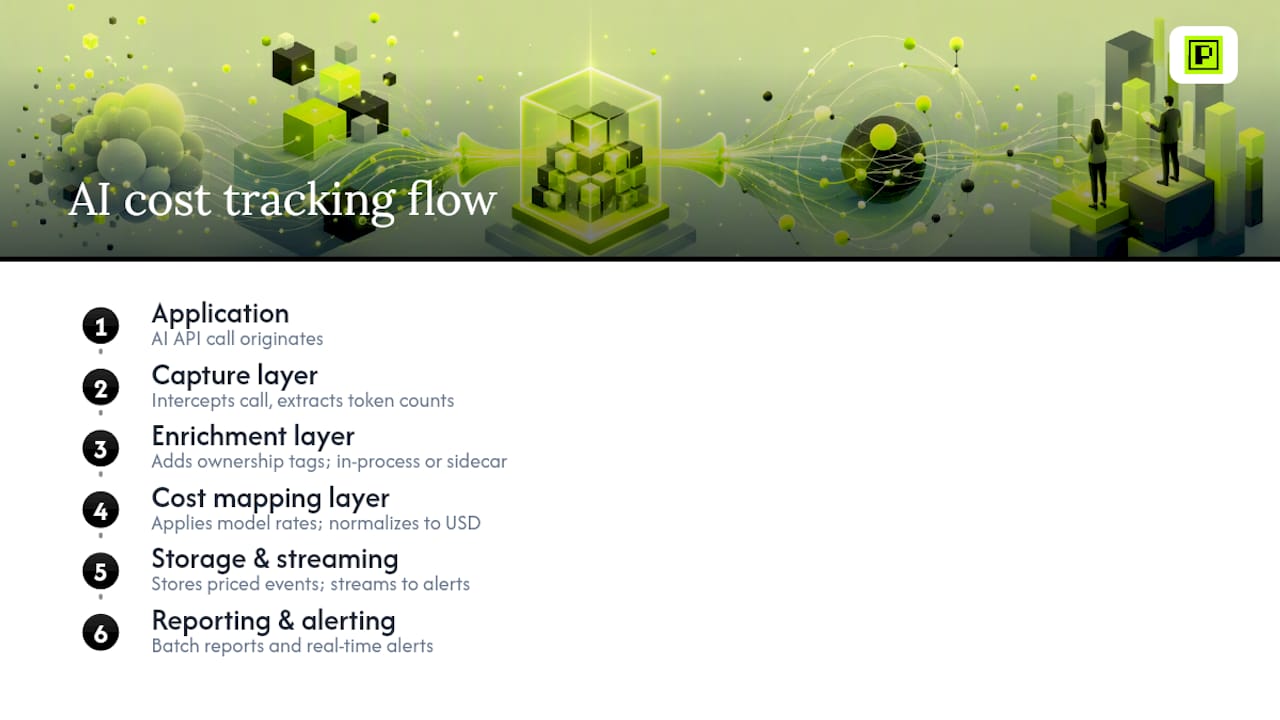
Capture layer. An SDK wrapper or agent intercepts each AI API call before it exits the application. This is where tokens_in, tokens_out, model, provider, and request_type are extracted from the response object. OpenAI-compatible SDKs expose token counts in the response body; Anthropic’s API surfaces them under usage. The capture layer should be synchronous with the request so no events are dropped.
Enrichment layer. The raw event is tagged with ownership and context metadata: owner_id, project_id, feature_id, billing_reference, and any policy tags. Enrichment can happen in-process (fastest, lowest latency) or via a sidecar service that joins against an ownership registry. The trade-off: in-process enrichment is faster but couples the application to the cost schema; a sidecar decouples them at the cost of added infrastructure.
Cost mapping layer. The enriched event is priced against a model price table. Each provider publishes per-token rates that change with model versions and discount tiers. The cost mapping layer applies the correct rate to produce inferred_cost in a normalized currency (USD). This layer must handle provider-specific billing units: OpenAI charges per million tokens, Anthropic per million tokens, and some providers charge per character or per operation. Normalizing to cost-per-1k-tokens enables cross-provider comparison.
Storage, streaming, and reporting. Priced events flow to a time-series store or data warehouse. Real-time alerting consumes the stream; batch aggregation feeds financial reports. Webhooks or event queues (Kafka, Pub/Sub, Kinesis) handle high-throughput workloads. Provider billing imports (CSV or PDF invoice parsing) serve as a reconciliation check, not the primary source of truth.
Pro Tip: Diagram the data flow before writing any instrumentation code. The diagram should show: application → capture SDK → enrichment service → cost mapping → event store → reporting/alerting. Gaps in that chain are where attribution breaks.
Required event data model fields
P402’s AI COGS Dashboard implements this event shape with metadata-only storage, meaning prompt text never persists. The audit trail is the economic event record, not the conversation.
What KPIs should you track for AI workloads?
Finance and engineering teams need a short, agreed roster of metrics before any dashboard is useful. Without shared definitions, engineering optimizes for latency while finance watches a number they cannot reconcile to the provider invoice.
- Tokens consumed (in/out): The foundational unit. Track input and output separately because most providers price them at different rates.
- Requests per period: Volume metric. Spikes here often precede cost spikes by minutes.
- Cost per 1k tokens: Normalized rate that enables model-switching comparisons.
- Cost per workflow run: The business-level unit. Maps AI spend to a product feature or customer action.
- Model-switch delta: The cost difference when routing the same request to a cheaper model. Quantifies optimization headroom.
- Agent and tool spend: For agentic workloads, each tool call is a billable event. Track separately from single-turn completions.
- Infrastructure COGS attributable to AI: GPU compute, vector database queries, and embedding storage that support AI features but appear in cloud bills, not provider invoices.
KPI ownership and anomaly signal
| Metric | Why it matters | Owner | Feeds anomaly detection? |
|---|---|---|---|
| Tokens consumed | Primary cost driver | Engineering | Yes |
| Cost per workflow run | Unit economics for product | Product | Yes |
| Model-switch delta | Optimization signal | Engineering | No |
| Agent/tool spend | Agentic cost visibility | Engineering | Yes |
| Cost per 1k tokens | Cross-provider benchmarking | Finance | No |
| Infrastructure COGS | Full AI COGS picture | Finance | Yes |
Converting provider billing units to a normalized cost-per-1k-tokens requires a price table keyed on (provider, model, request_type). When a provider changes pricing, update the table and re-price historical events using the effective date. This is the reconciliation step that catches invoice mismatches before they reach the general ledger.
Implementation checklist: from discovery to go-live
Follow this sequence. Skipping steps, particularly owner mapping and reconciliation, produces a tracker that engineering trusts but finance cannot use.
- Inventory all AI model usage. Pull provider billing dashboards for OpenAI, Anthropic, and any cloud-hosted models (AWS Bedrock, Azure OpenAI, Google Vertex AI). List every active model, the team consuming it, and the approximate monthly spend. This is the baseline.
- Define the ownership taxonomy. Agree on
owner_idvalues before writing instrumentation code. A flat list of team names works for small organizations; a hierarchicalorg/team/projectstructure scales better. Finance and engineering must agree on this schema together. - Instrument the capture layer. Wrap AI client calls with an SDK that extracts token counts and model identifiers from the response. For OpenAI-compatible APIs, the
usageobject in the response body containsprompt_tokensandcompletion_tokens. For token-level metering, P402 provides an OpenAI-compatible SDK integration that emits events without modifying application logic. - Attach enrichment metadata. Inject
owner_id,project_id, andfeature_idat the call site or via middleware. Use environment variables or a config service so ownership tags do not require code changes when teams reorganize. - Deploy the cost mapping layer. Load the provider price table. Apply rates to produce
inferred_costper event. Validate against a known invoice: sum the inferred costs for a billing period and compare to the provider invoice total. A variance under 2% is acceptable; higher variance indicates a pricing table gap or a missing model. - Configure storage and streaming. Route events to a time-series store for real-time alerting and a data warehouse for batch reporting. Teams that cannot yet emit events can upload provider invoices (PDF or CSV) to parse normalized daily spend and model-level breakdowns as an interim step.
- Set up reconciliation cadence. Run a weekly reconciliation job that matches provider invoice line items to event-level sums by
billing_reference. Log mismatches. Investigate any variance above threshold before the invoice is paid. - Test with synthetic load. Fire known request volumes against a test environment and verify that event counts, token sums, and inferred costs match expected values. This catches enrichment gaps before production traffic runs through the system.
- Go live and monitor. Enable real-time alerting on cost-per-period thresholds. Assign an on-call owner for anomaly alerts in the first 30 days.
Sample event payload (JSON):
{
  "event_id": "evt_01j9xk2m",
  "timestamp": "2026-01-15T14:32:07Z",
  "provider": "openai",
  "model": "gpt-4o",
  "tokens_in": 812,
  "tokens_out": 340,
  "request_type": "chat",
  "owner_id": "team-platform",
  "project_id": "proj-search",
  "feature_id": "semantic-search-v2",
  "inferred_cost": 0.00918,
  "currency": "USD",
  "billing_reference": "inv-2026-01"
}
How do you govern AI budgets and stop runaway spend?
Governance without automation is a postmortem exercise. By the time a finance team notices an overage on a monthly invoice, the spend has already occurred. The FinOps Foundation’s cost-management framework formalizes the cross-functional ownership model that makes automated controls effective: finance sets the budget, engineering owns the instrumentation, and product owns the workflow-level spend targets.
Budget scoping patterns:
- Team budget: A monthly token or dollar ceiling per
owner_id. Simplest to implement; least granular. - Product budget: A ceiling per
project_id. Maps to a P&L line. - Workflow budget: A ceiling per
feature_id. The most operationally useful because it ties spend to a specific user action or pipeline run. - Customer budget: For SaaS products with per-customer AI features, a ceiling per customer account prevents one tenant from consuming disproportionate capacity.
Anomaly detection methods. Baseline statistics (rolling mean plus standard deviation) catch straightforward volume spikes. Seasonality-aware rules (day-of-week or hour-of-day baselines) reduce false positives for workloads with predictable patterns. ML-based detectors handle novel spike shapes that rule-based systems miss, but they require at least 30 days of history to calibrate.
Automated controls, in escalation order:
- Soft limit: Alert fires to Slack, PagerDuty, or email when spend crosses 80% of budget.
- Hard stop: Requests are rejected or queued when spend crosses 100% of budget. Implement at the capture layer so the control is enforced before the API call exits the application.
- Model routing: When a workflow’s spend approaches its ceiling, route subsequent requests to a cheaper model variant. Token brokering and cost-aware routing are established techniques for this pattern.
- Cost quarantine: Isolate a runaway
feature_idby suspending its API access without affecting other workflows.
Incident response playbook:
- Investigate: identify the
feature_idandowner_iddriving the spike. - Tag: annotate the anomalous events with an incident reference for audit.
- Rollback or reroute: disable the feature or switch to a cheaper model.
- Postmortem: document root cause, update budget thresholds, and add a regression test.
Pro Tip: Configure the enterprise AI budget dashboard to surface per-workflow spend in real time. Budget-aware model selection — routing to a smaller model when a workflow nears its ceiling — is the single highest-leverage automated control available without code changes to the application.
What optimization levers actually reduce AI COGS?
Ranked by typical impact-to-effort ratio, these levers apply to most generative AI workloads.
-
Model tiering and routing. Route requests to the cheapest model that meets quality requirements. A classification task that passes on
gpt-4o-minidoes not needgpt-4o. Measure quality with a held-out eval set, then set routing rules byrequest_typeorfeature_id. This is usually the highest-impact lever with minimal code change. -
Prompt engineering and token trimming. Shorter prompts cost less. Audit the 10 highest-cost workflows by average
tokens_in. Trim system prompts, remove redundant context, and use structured output formats that reduce verbose completions. Reducingtokens_inon a high-volume workflow through prompt trimming compounds significantly at scale. -
Caching and memoization. Identical or near-identical requests can return a cached response. Semantic caching (embedding-based similarity lookup) extends this to paraphrased inputs. Cache hit rates can be significant on FAQ-style or templated workflows, improving overall cost efficiency.
-
Request batching. Some providers offer batch APIs at reduced per-token rates. Asynchronous workloads (document processing, nightly summarization) are candidates. Latency tolerance is the constraint; real-time user-facing features cannot batch.
-
Sampling and temperature controls. Lower temperature values reduce output variance and often reduce output length. For deterministic tasks (classification, extraction),
temperature=0produces shorter, more consistent completions. -
Hybrid on-premises and cloud routing. For high-volume, latency-tolerant workloads, self-hosted open-weight models (Llama 3, Mistral) can replace cloud API calls at lower marginal cost. The break-even depends on GPU infrastructure cost versus provider API spend.
Before/after example — semantic search workflow:
The AI cost optimization readiness assessment maps which levers apply to a given workload before any code is written.
How do you produce audit-ready financial reports for AI spend?
Finance and compliance teams need exportable evidence, not just dashboards. The minimum audit package contains three artifacts: an event-level export, an aggregated P&L view, and a reconciliation log.
Export formats and column sets:
- Event-level CSV/JSON: One row per event. Columns:
event_id,timestamp,provider,model,tokens_in,tokens_out,inferred_cost,owner_id,project_id,feature_id,billing_reference. This is the raw audit trail. - Aggregated P&L view: Grouped by
project_idand calendar period. Columns:project_id,period,total_tokens,total_cost,request_count,avg_cost_per_request. Finance uses this for chargeback and budget variance reporting. - Reconciliation log: Matched pairs of provider invoice line items and event-level sums, with variance column. Auditors use this to confirm that metered costs align with billed amounts.
Auditor checklist:
- Event-level traceability: every cost line links to a unique
event_id. - Cost mapping justification: the price table version and effective date used to compute
inferred_costis logged. - Reconciliation artifacts: the variance between event sums and provider invoices is documented and signed off.
- Retention compliance: events are retained for the required audit window (typically 7 years for financial records under US GAAP guidance; confirm with legal counsel).
Retention policy guidance:
Metadata-only tracking, capturing tokens and cost without prompt text, satisfies audit requirements while minimizing data retention risk. The P402 trust and privacy controls documentation covers retention modes and privacy configurations in detail.
Surfacing AI cost data into a general ledger requires a journal entry mapping: project_id maps to a GL account code, period maps to an accounting period, and total_cost becomes the debit entry. Chargeback systems consume the aggregated P&L view and allocate costs to internal cost centers or external customers.
Build vs. buy: when does an in-house tracker make sense?
Most teams underestimate the ongoing maintenance cost of a homegrown tracker. The build decision looks attractive at week one; it looks different at month six when the price table has changed three times, a new provider was added, and the reconciliation job is failing silently.
Decision checklist:
- Event volume: Under 100,000 events per day, a lightweight in-house solution is feasible. Above that threshold, storage, streaming, and query performance require dedicated infrastructure investment.
- Multi-provider support: Each provider has a different billing schema, API response format, and pricing update cadence. Supporting three or more providers in-house is a sustained engineering commitment.
- Auditability requirements: If finance or compliance requires exportable, timestamped, immutable event records, the audit trail must be a first-class feature, not an afterthought. Building this correctly takes longer than most teams estimate.
- Team bandwidth: A tracker that runs on a shared engineering rotation degrades. Anomaly detection rules go stale, price tables lag, and reconciliation jobs accumulate technical debt.
- Time-to-value: A buy decision typically delivers working attribution in days; a build decision delivers a minimum viable tracker in weeks and a production-grade system in months.
- FinOps alignment: The FinOps Foundation’s framework recommends cross-functional ownership and standardized cost allocation. A bought platform that already implements FinOps patterns reduces the governance design work.
Vendor evaluation criteria:
- Real-time attribution (event-level, not invoice-level)
- Metadata-only tracking with configurable privacy modes
- Exportable financial reports in standard formats (CSV, JSON)
- Native integrations with OpenAI, Anthropic, and major cloud providers
- Budget and alert configuration per team, project, and workflow
- Audit log with immutable event records
Hybrid approach for low-risk migration: Start with provider billing imports (CSV/PDF) to establish baseline spend visibility. Add event-level metering for the highest-cost workflows first. Expand instrumentation incrementally. This reduces migration risk and delivers value before full instrumentation is complete.
How P402 implements event-level metering for enterprise teams
P402 records every AI API request as a metered economic event. The event captures ownership, workflow, model, provider, token counts, inferred cost, budget policy result, and outcome, with no prompt text stored by default. This is the metadata-only tracking pattern described throughout this guide, implemented as a production system.
Example event flow:
- Application calls the AI provider API through the P402 SDK (OpenAI-compatible).
- P402 intercepts the request, extracts token counts and model from the response.
- The event is enriched with
owner_id,project_id, andfeature_idfrom the request context. - The cost mapping layer applies the current provider price table to produce
inferred_cost. - The event is written to the audit log and streamed to the real-time dashboard.
- Budget policy is evaluated: if the workflow is within budget, the response is returned; if over budget, the configured control (alert, reroute, or reject) fires.
- The event is available for export to finance within seconds of the API call completing.
P402 capability summary:
| Capability | Implementation detail |
|---|---|
| Real-time attribution | Per-event, sub-second latency from request to dashboard |
| Metadata-only tracking | No prompt or completion text stored; economic event only |
| Live model routing | Routes across many models based on budget and policy |
| Export formats | CSV and JSON; event-level and aggregated P&L views |
| Audit evidence | Immutable event log with cost mapping justification |
| Provider integrations | OpenAI, Anthropic, and major cloud AI providers |
| Budget controls | Per-team, per-project, per-workflow soft and hard limits |
Finance and engineering collaboration scenario. An engineer notices a cost spike on the semantic-search-v2 workflow at 2:14 PM. The P402 AI spend audit dashboard shows the spike originated from a single owner_id running a batch job without a workflow tag, causing all costs to roll up to an unattributed bucket. The engineer adds the missing feature_id tag and reruns the reconciliation. The finance owner receives an updated export within minutes, with the corrected attribution reflected in the P&L view before end of day.
The gap most enterprise rollouts miss
Enterprise AI cost tracking fails in predictable ways. The failure modes are not technical. They are organizational.
The most common: teams instrument the capture layer correctly but skip the ownership taxonomy step. Every event arrives with owner_id = "default" because no one agreed on the tagging schema before go-live. The result is a technically functional tracker that produces no actionable attribution. Fix: define and enforce a tagging policy before writing a single line of instrumentation code. Treat owner_id and feature_id as required fields with validation at the capture layer, not optional metadata.
Second failure mode: treating provider invoices as the authoritative cost record. Invoices aggregate spend across a billing period and obscure which workflows, teams, or customers drove which costs. A team that reconciles only at invoice time cannot enforce real-time budgets or respond to anomalies before they compound. Event-level metering is the only approach that supports both real-time controls and audit-grade reporting.
Third: mis-scoped budgets. A single team-level budget ceiling does not prevent one high-volume workflow from consuming the entire allocation. Workflow-level budgets, mapped to feature_id, are the correct granularity for operational control. Finance sets the team ceiling; engineering sets the workflow sub-limits. Both need visibility into the same event stream.
The fix for all three is the same: agree on the data model and ownership schema first, instrument second, and build governance controls on top of a trusted event record. Teams that reverse this order spend months cleaning up attribution data instead of acting on it.
P402 delivers event-level metering from day one
Instrumenting AI cost tracking from scratch takes weeks. P402 compresses that timeline by providing a production-ready event metering layer that integrates with OpenAI-compatible APIs without modifying application logic.
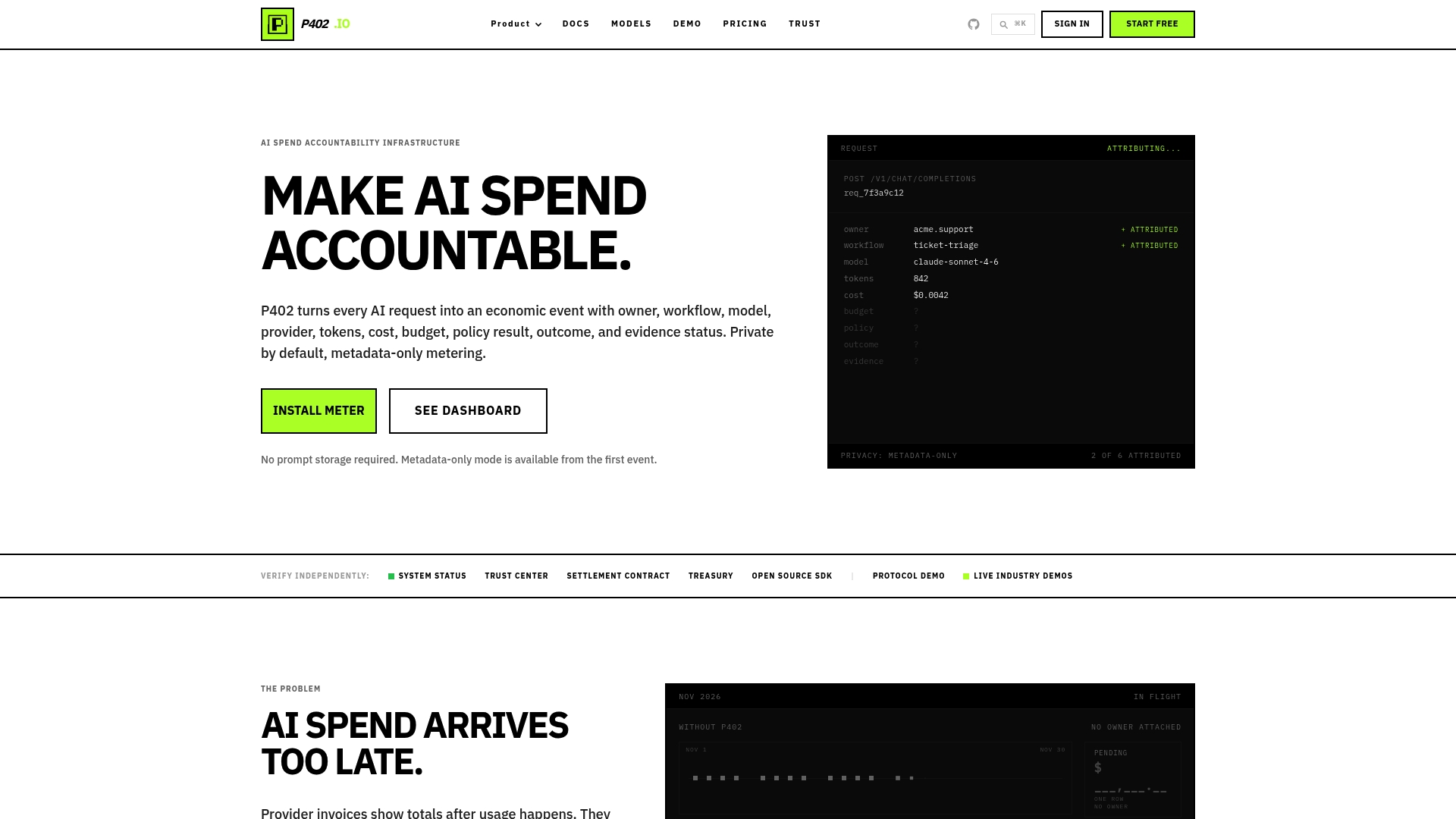
A P402 pilot delivers three concrete outputs in 30 days: a complete instrumentation review of existing AI API usage, 30 days of event-level metering with real-time attribution to owners and workflows, and an export package formatted for finance, including event-level CSV, aggregated P&L view, and reconciliation log. Engineering gets a working cost tracker. Finance gets audit-ready exports. Compliance gets an immutable event log with metadata-only storage.
The enterprise AI budget dashboard surfaces per-workflow spend, budget utilization, and anomaly alerts in real time. For teams evaluating the platform, the P402 pricing page details metered event tiers and enterprise contract options.